

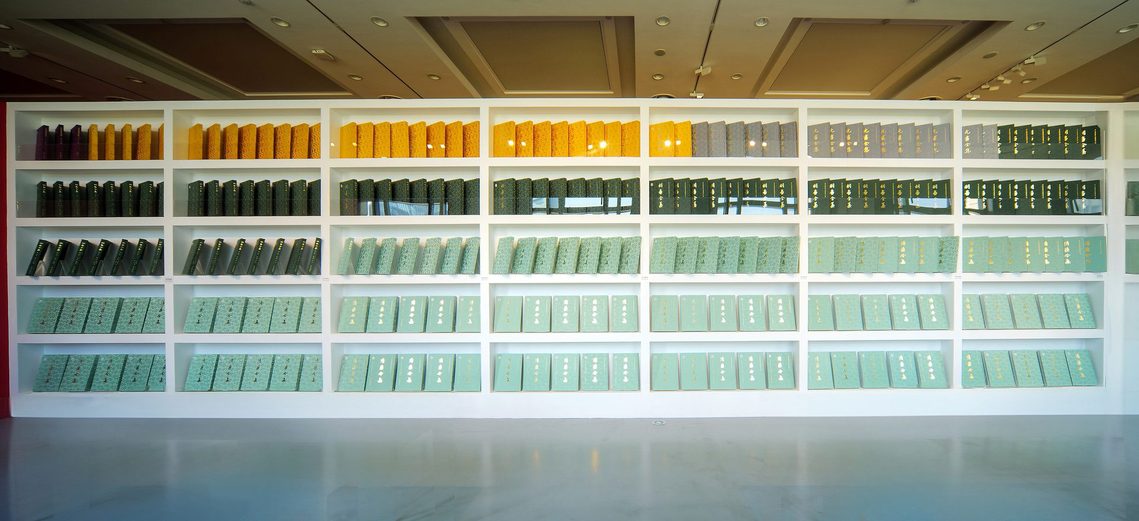
The complete Collection on display — 232 books in 62 volumes, arranged by dynasty.
About the Project
A Comprehensive Collection of Ancient Chinese Paintings is a landmark publishing and research project jointly undertaken by Zhejiang University and the Zhejiang Provincial Administration of Cultural Heritage. The most comprehensive pictorial collection of ancient Chinese painting assembled to date, it comprises 232 books in 62 volumes and reproduces 12,405 paintings (sets)—works on paper, silk (including brocade and damask), linen, and other materials—drawn from 263 museums and cultural institutions in China and abroad.
Begun in 2005 and completed in 2024, the project is the first systematic, nationwide effort to gather and synthesize a country’s ancient paintings from collections worldwide, making these artistic resources available to scholars and audiences everywhere. Using advanced image-acquisition and digital-processing technologies, it achieves high-fidelity reproduction of the original works, bringing together masterpieces that had long been dispersed across collections. The result is an encyclopedic resource for the study of Chinese art and culture and an enduring record of classical art history.
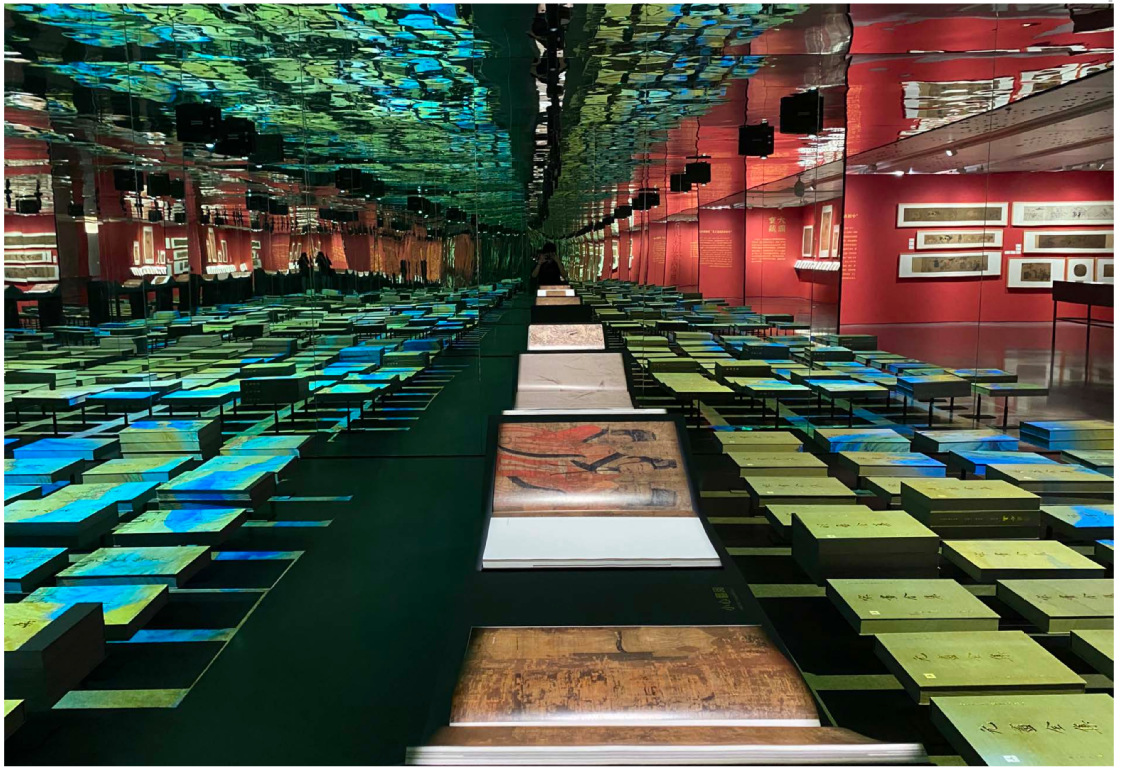
The Collection presented to the public in an immersive exhibition.
Painting Across the Dynasties
The Collection traces the evolution of Chinese painting across more than two millennia—a tradition marked by a long history, distinctive period and regional styles, and enduring artistic lineages.
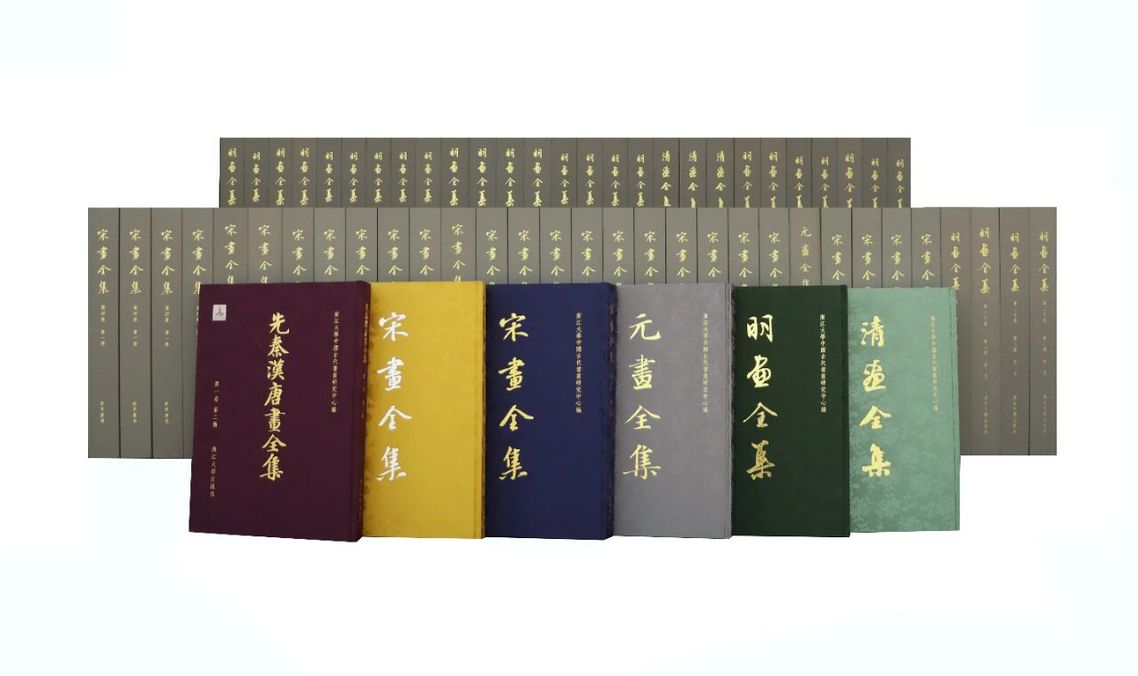
The Collection is organized into era-based series, from Pre-Qin, Han and Tang through Song, Yuan, Ming, and Qing.
From the Pre-Qin Period to the Tang Dynasty — The Rise of Form
Chinese painting emerged as early as the 5th century BCE and, by the 1st century BCE, had become a dominant art form. Early works—murals, screens, scrolls, and silk banners in palaces and temples—served religious, political, and social purposes and favored lifelike figure painting. By the Tang dynasty, landscape, flower, and animal subjects had emerged as independent genres, and masters such as Wu Daozi transformed line drawing and ink, giving rise to ink-wash painting.
The Song Dynasty — The Height of Classical Art
Song painting reached an unprecedented refinement, shaped by the Imperial Academy’s “Court Style,” literati painters, and folk traditions. Northern Song landscape masters such as Li Cheng, Fan Kuan, and Guo Xi achieved a monumental realism, while Southern Song artists—among them the Four Great Painters Li Tang, Liu Songnian, Ma Yuan, and Xia Gui—developed a more lyrical, atmospheric aesthetic. Literati themes such as ink plum and bamboo also took root.
The Yuan Dynasty — Literati Ideals
Yuan painting was defined by the literati spirit, with landscape as an expression of the artist’s inner world. The Four Great Painters of Yuan—Huang Gongwang, Wang Meng, Wu Zhen, and Ni Zan—brought personal brushwork and a reclusive sensibility to new heights, favoring monochrome ink and the “Four Gentlemen” motifs of plum, orchid, bamboo, and chrysanthemum.
The Ming Dynasty — A Diversity of Schools
Ming painting developed along many paths, from the revived Court Style and Zhejiang School to the flourishing literati schools of Suzhou and, later, Songjiang. The Four Great Painters of Ming—Shen Zhou, Wen Zhengming, Tang Yin, and Qiu Ying—were central figures, and late-Ming contact with Western missionaries introduced new influences, especially in figure painting.
The Qing Dynasty — Synthesis and Renewal
Qing painting synthesized earlier traditions and blended Chinese and Western techniques. Landscape schools looked back to the ancient masters, bird-and-flower painting saw innovations such as Yun Shouping’s “boneless” technique, and the Shanghai School—with artists including Zhao Zhiqian, Ren Bonian, and Wu Changshuo—brought a modern sensibility that opened a new phase in Chinese painting.
Exchanges Between Civilizations
Painting has long been a bridge between cultures. Along the Silk Road, Buddhist art traveled into China, as seen in the murals of Dunhuang; between the 3rd and 6th centuries, Chinese painting shaped Japanese “Kara-e” and reached the Korean peninsula through trade and diplomacy. During the Ming and Qing dynasties, exchange between China and the West blended artistic ideas and techniques in both directions.
Outstanding Universal Value
As an art of both representation and expression, ancient Chinese painting unites the depiction of the world with the artist’s individual feeling. These works record history and speak to the present, offering a dialogue between a classical tradition thousands of years old and the contemporary world.
UNESCO’s Operational Guidelines for the Implementation of the World Heritage Convention (2021) describes Outstanding Universal Value as cultural or natural significance so exceptional that it transcends national boundaries and holds common importance for all humanity, present and future. A Comprehensive Collection of Ancient Chinese Paintings presents that value to the world—works that belong at once to history and to the present, to China and to all.